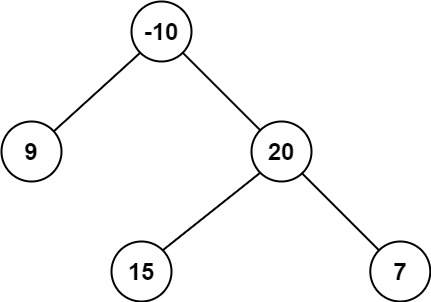
A path in a binary tree is a sequence of nodes where each pair of adjacent nodes in the sequence has an edge connecting them. A node can only appear in the sequence at most once. Note that the path does not need to pass through the root.
The path sum of a path is the sum of the node's values in the path.
Given the root of a binary tree, return the maximum path sum of any path.
Example 1:
Input: root = [-10,9,20,null,null,15,7]
Output: 42
Explanation: The optimal path is 15 -> 20 -> 7 with a path sum of 15 + 20 + 7 = 42.
Binary Tree Maximum Path Sum - LeetCode
https://www.youtube.com/watch?v=Osz-Vwer6rw&list=PL_z_8CaSLPWekqhdCPmFohncHwz8TY2Go&index=49&ab_channel=AdityaVerma
/**
 * Definition for a binary tree node.
 * struct TreeNode {
 *     int val;
 *     TreeNode *left;
 *     TreeNode *right;
 *     TreeNode() : val(0), left(nullptr), right(nullptr) {}
 *     TreeNode(int x) : val(x), left(nullptr), right(nullptr) {}
 *     TreeNode(int x, TreeNode *left, TreeNode *right) : val(x), left(left), right(right) {}
 * };
 */
class Solution {
public:
    int maxPathSum(TreeNode* root) {

        int res = INT_MIN;
        solve(root,res);
        return res;

    }
    int solve(TreeNode* root,int &res) {

        if(!root)
            return 0;

        int l = solve(root->left,res);
        int r = solve(root->right,res);

        int temp = max(max(l,r)+root->val,root->val);
        int ans = max(temp,l+r+root->val);
        res = max(res,ans);

        return temp;
    }
};
// Time Complexity : O(n)
// Space Complexity : O(h) where h = height of tree